


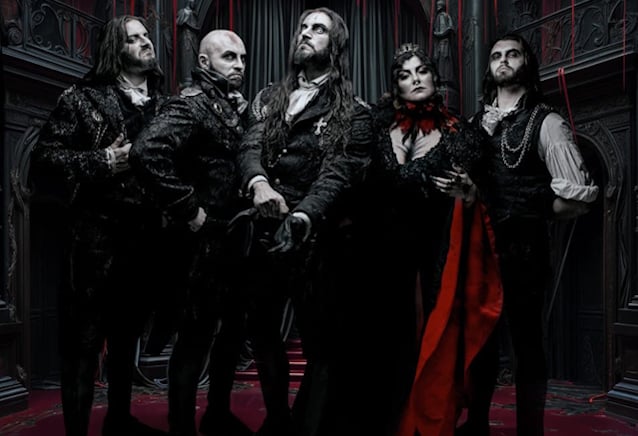
FLESHGOD APOCALYPSE's FRANCESCO PAOLI Emerges From Near-Death Experience With A New Lease On Life: 'You Realize How Lucky You Are'
April 21, 2026By David E. Gehlke
Francesco Paoli freely admits he's lucky to be alive. The founder and frontman of Italian symphonic death metal horde FLESHGOD APOCALYPSE suffered near-fatal injuries stemming from a 2021 rock climbing accident near his Spoleto home. He broke multiple bones (he estimates 25),suffered severe nerve damage in his left arm and lost such a significant amount of blood that doctors told him he almost died. The physical injuries were tough, as was the psychological toll — doctors nearly had to amputate his left arm, which would have rendered him permanently unable to play bass and guitar. Paoli, though, through extensive rehabilitation and relentless determination, recuperated and is nearly back at full strength. Moreover, the ordeal provided him more than enough inspiration to pen the storyline for FLESHGOD APOCALYPSE's latest studio foray, 2024's "Opera".
The grandiosity and tidal wave of pomposity on "Opera" and its "Voleno" (2019) and "King" (2016) predecessors are put into perspective when considering that FLESHGOD APOCALYPSE got its start as a technical death metal band. Such a transition was not without its obstacles, but overcoming hurdles appears to be a recurring thread for the Italians, who, by all accounts, have emerged as one of the more notable extreme metal practitioners representing their country. On the ramp-up to their April-May trek across the United States in support of AVATAR, BLABBERMOUTH.NET got Paoli on the horn to learn how he's adjusted after his accident and how FLESHGOD APOCALYPSE continues to grow.
Blabbermouth: Your injuries and near-death experience have been well-publicized. What kind of adjustments have you made to tour and even function on a daily basis? What has it done for your outlook on life?
Francesco: "I appreciate it more. In a way, I appreciate life, in general, more than before. When you are that close to losing everything, things that you always took for granted, like, 'Okay, I'm a musician. It's okay. It's cool.' But you never realize how lucky you are. I always took it a little bit for granted. The touring life, now, is a gift even more than before. Practically, the very first couple of tours after the accident were a little bit tough because I was still in pain most of the time. Now, I'm almost a hundred percent recovered. I mean, I will never be one hundred percent recovered because some stuff is unfixable. I'm adjusting to it. For example, I don't feel my left hand. [Laughs] I feel half of it. I had to figure out how to make it work because my nerve isn't working at one hundred percent. Let's say, after the transplant, it's working ten percent. I don't feel or move my fingers well. At the same time, I don't want to lose what I have. I appreciate what I have even more than before. I don't care if they don't move how I want or if I don't feel it. It's tricky."
Blabbermouth: Touring is not always glamorous. Are you getting what you need to make the grind of the road accommodating?
Francesco: "I'm not that different than before. I have pain in my leg, the issue with my hand and of course, I have to take care of my elbow and all the nerves that have been fixed with very heavy surgery. Before the accident, I was doing crowd surfing. Now, I have to think twice before doing something like that. You never know. It's maybe more fragile, the whole structure. But I don't have a specific need or anything that promoters or, at the level we are, cannot provide. I feel like I can do it, and I do sports and try to keep myself healthy, so that also helps the whole process. The pain was my concern at the very beginning because I was like, 'Oh, shit. If I'm going to be in pain all the time and on top of that, there's also all this stress and uncomfortable situations that you can find on tour, then it might become something unbearable with time.' I was lucky. My body adjusted pretty well to the titanium and all the screws and everything. It adjusted well. Also, the pain is when I have pain, it's sometimes. It's not very often. It's totally fine."
Blabbermouth: How have you been dealing with the psychological element of singing the songs from "Opera" every night, which are about your ordeal?
Francesco: "There was a long discussion before writing the album. Before we made the final decision to make an album about it, because this was my main concern, and at the same time, I'm one of those guys who try to keep their private life private. Also, this is mostly lows. When something good happens to me, I want to share it, like, 'We played this killer show.' Or, 'We played this killer festival' or the 'Album is doing super well.' I want to share and involve people in our success, but when it comes to showing my fragility, to show all the issues and all the psychological problems that were connected, because before this accident, I felt pretty self-confident. All of a sudden, I wasn't. It was like, 'I don't know if it's good to show people this side of myself.' But in the end, I felt like, 'Maybe I have to accept this new me, because there's nothing I can do, apart from training or pushing as hard as possible. In the end, if I'm going to be scared or depressed, I have to deal with it and accept it.' It was like, 'You know what? Maybe I can talk about it and see if this thing helps me when I'm going through this problem.'
"I started talking to the other guys in the band, my wife and my parents. I started to feel relieved. Like, 'I should have said this to my mother a long time ago.' 'I should have seen the side of myself a long time ago.' I see that people forgive this weakness. It's not even a weakness anymore. It's an aspect of my life. Before, I was writing a song, then I was sending a song that was done and all of the process, it was the back and forth, all this stuff never appeared or surfaced. They got it all: 'This guy is super cool who is writing the music.' They never saw the real process, the real behind the scenes, like me, going back and forth and getting despair and depressed because I didn't like it. All of a sudden, they started doing it, and they said, 'Oh, wow.' Also, that process evolved into something better because I got input from the other guys. At the very beginning, as I said, I was concerned, but now, I feel, 'Oh, wow. It's one of the best choices of my life.' I don't have to hide anymore. I can be myself all the time. They understand me. Even if I don't deliver, I cannot be one hundred percent every day. If some days, I'm 40 percent, they accept it. That helps me a lot. I was also concerned about others' judgment. Now, I'm not anymore. It's like, 'Here I am. Here's what I am today, which sucks. I accept it, you accept it, let's look into tomorrow. Let's see what comes.'"
Blabbermouth: "Till Death Do Us Part" is a fitting album closer, showing that there's a light at the end of the tunnel. Do you find its resonating with other people?
Francesco: "It's an album about an accident, let's call it a misadventure that could have led to death. I was very lucky. At the same time, since I got this opportunity to revert, it feels like a rebirth. I got this second chance, and I have to deserve it. I have to show people, if you do the right thing, if you listen to the doctors, if you listen to people around you, and you're not just a stubborn piece of shit, doing the same things over and over, you can improve. You can live with disabilities, you can live with psychological issues. You can start managing them. Sometimes you will never heal. Also, accepting that is part of the healing process. I have to share this with other people. Many times in the past, I felt low; sometimes, I felt like the world was falling apart, and I needed a push into something that would give me this extra strength to restart. I always found it in art, especially in my experience with music. Whatever it is, it can be a metal song, a country song or a pop song, whatever. Something in that moment gave me this extra push and told me, 'Francesco, wake up. You can do it. Just start doing something. Do not wait.' I was like, 'Yeah, maybe it's time to move. Change the style of the lyrics and move into this topic.' In the past, we were already talking about inner issues or philosophical topics; mostly, we were discussing them in philosophical terms. Sometimes very poetic, sometimes we took inspiration from literature. Everything sounds much more complicated than it is because the concept was still there. It was depression, anxiety, fear, hope, whatever, but we were keeping too much. It wasn't direct enough to find yourself in the lyrics. Something was not clicking one hundred percent. Now, it was 'Let's try to make an opera, to be as poetic as possible.' We also wanted to treat some subjects, treat the subject matter that we know and describe and talk about an experience that we had, so it's real. The game changed completely. With this album, before, it was like, 'I love the album. Nice music. Nice solo. Fast drumming.' This time, it's more, 'I see myself in the lyrics. I relived this. I wanted to say the same things to my mother. I wanted to say the same things to my boyfriend, girlfriend, wife, husband, whatever.' It's the next step in our relationship with our fanbase. The kind of energy that has been established with this approach, I will never go back."
Blabbermouth: You will be touring the States in April. Your progress here has been steady. Why do you think it's a good territory for FLESHGOD APOCALYPSE?
Francesco: "The United States is probably one of the first super-big countries or 'market,' which is what they call it in the industry, that welcomed us from the very beginning. There is a special relationship with what we do. It's also probably connected to some kind of admiration for our culture. There are a lot of Italian Americans there. Of course, Italy has long been the cradle of culture. What we try to integrate into our music is that as well. For sure, this aspect of our music is really clicking with Americans. We also want to entertain the people on several levels. It's not just playing the music live. It's also bringing a show, which means all the theatrical stuff that goes on, like the small sketches between ourselves, the production, the lights, the staging and everything. That kind of stuff isn't super easy when you have an ocean in between. The more we come back to the United States, the more things grow. We got the opportunity, finally, to bring some kind of a show with 'Opera'. Also on that side, we are not going back. Fortunately, the band is growing more and more every time. It's a slow and steady growth. It's something that, in a way, gives us some confidence because we feel like we have a solid fanbase, so whenever we come back, we know that we'll have a great audience and great shows. You can invest in that. Otherwise, it's a little bit of a gamble. A crazy-big production, super expensive, lots of work and then they don't really care about you because you can be super hyped and the next day, nobody will want to hear about you anymore. What we built was really on the road, winning a fan one by one. Yeah, we're confident now to come back with a production. There are some challenges you can find when touring the United States — it's worth working to make it work. These people deserve it, after all the support they've given us."
Blabbermouth: Do you think your origins as a technical death metal band have anything to do with that? The States have been a hotbed for that style.
Francesco: "It's been an inspiration. They ask us what genre, the elements, the original genre you wanted to play from the very beginning, and I also mention that when it comes to the extreme side, the death metal side, 90 percent of the bands are from America. [Laughs] We grew up with DEICIDE, MORBID ANGEL, these kinds of bands. Of course, AT THE GATES, all the Swedish death metal influences, ENTOMBED, all of these guys influenced us because they were already projecting death metal into this melodic death metal thing. The nasty shit, what you really need to conjure the symphonic stuff, which is more melodic and open and epic, you needed something very nasty. There's nothing nastier than IMMOLATION or MORBID ANGEL. The technical aspect is there because, at the very beginning, we were trying to incorporate the complexity of classical music into the music. Then, we made it work differently, including the piano and also the symphonic arrangements. Yeah, at the very beginning, it was different."
Blabbermouth: Some of the bands you mentioned evolved, but they never would have gone in a symphonic direction like you. Was it, at the time, a risk?
Francesco: "Thinking about it now, I can tell you that it was. When we did it, we were so young and naïve, so we didn't realize it. When we started using Paolo [Rossi, bass], we then had Veronica [Bordacchini] do clean vocals. It's like 'I've heard that album' or 'I've heard that before' from different genres, and there are no boundaries; there are no limits. What's the point of not doing it? We were like, 'Let's do it.' Everybody in the industry was like, 'I don't know if it's the right move. You are running into a shitstorm.' We were like, 'Ah, maybe yes or no. We will prove you wrong.' For a long time, it was 50/50. Now, we feel like, yeah, people recognize us as a symphonic death metal band. I'm proud that people say, 'As soon as I hear it's the first four notes, I know it's you.'"


 Prev
Prev 